The setting
The valleys around Lake Lucerne in the late 13th century were a strange place: high alpine pastures, small communities of free farmers, on a vital trade route over the Gotthard Pass between northern Europe and Italy. They were technically subjects of the Holy Roman Empire, but they enjoyed an unusual degree of self-rule because the Empire was distant, the terrain was murderous, and the Habsburg dukes who'd been given the area as a hereditary fief weren't quite strong enough to crack down.
When the Habsburg Rudolf I died in 1291, the three forest cantons saw an opportunity to lock in their privileges before his successor could close the gap.
The actual founding document
On August 1, 1291 — or thereabouts; the date is traditional — representatives of three small communities signed the Federal Charter (Bundesbrief): the men of Uri, Schwyz, and Unterwalden. The text is in Latin, not heroic in tone, and mostly administrative:
... they have, in good faith, promised to assist each other... in all things and at all times... against all who may inflict on them or any of them any violence, molestation, or injury, or plot any evil against their persons or goods.
It's a mutual-defence pact between three small mountain communities. There is nothing in it about democracy, nationhood, or apples on children's heads. But it survived — physically; you can see the original in the Bundesbriefmuseum in Schwyz — and it became the foundation of a state.
The Schiller version (and what's actually true)
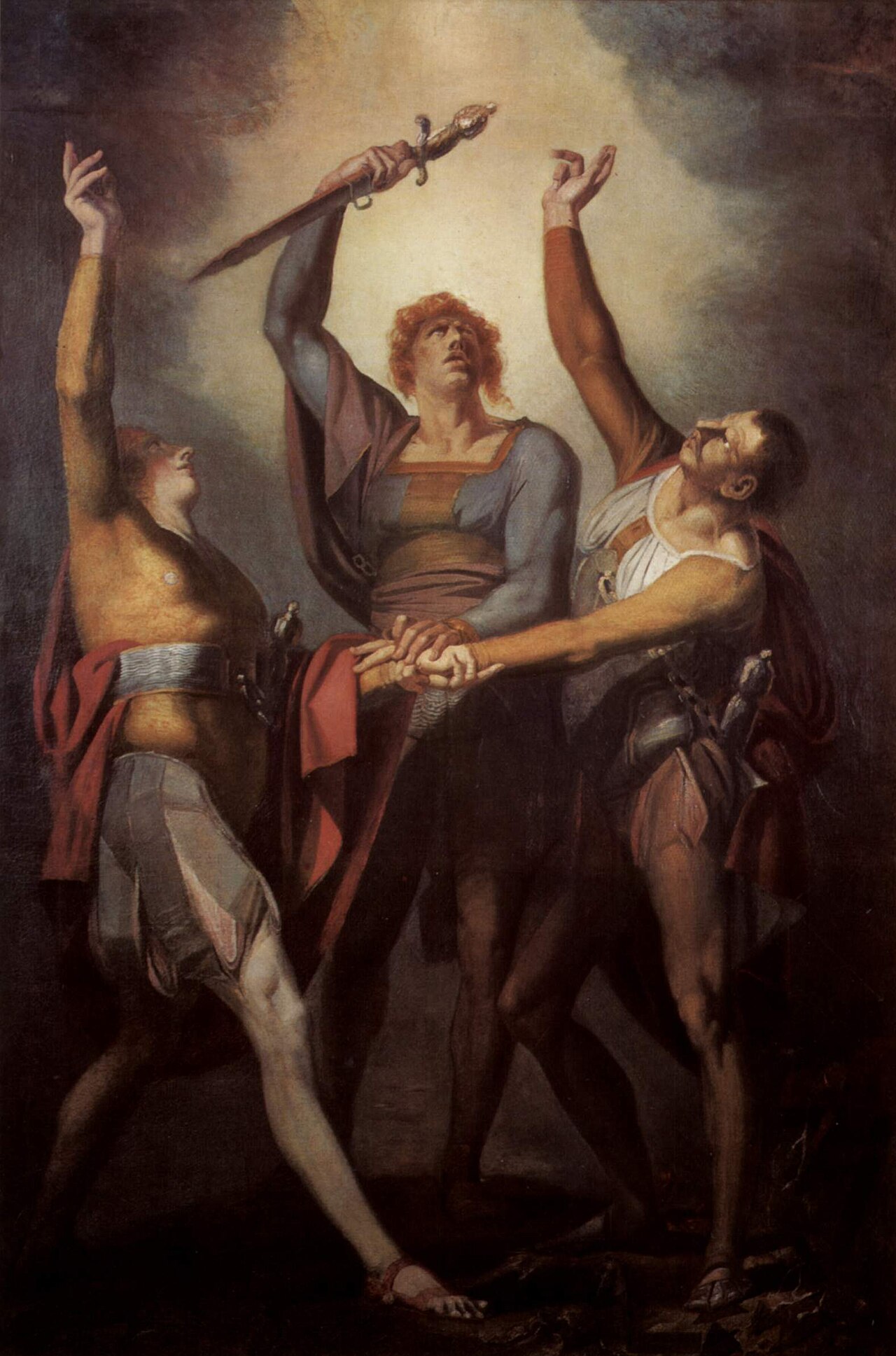
Most of what people picture when they think of Switzerland's founding comes from Friedrich Schiller's 1804 play William Tell:
- Three peasants — Werner Stauffacher, Walter Fürst, Arnold von Melchtal — swearing an oath on the Rütli meadow under the open sky to defend Swiss freedom.
- The tyrannical Habsburg bailiff Gessler putting his hat on a pole and demanding everyone bow to it.
- The marksman William Tell refusing, being forced to shoot an apple off his son's head with a crossbow, then later assassinating Gessler.
It is wonderful theatre. It is also, mostly, not contemporary history. The Tell story first appears in chronicles written more than 150 years after it supposedly happened, contains plot elements borrowed from earlier Scandinavian folklore, and refers to people who can't be matched to any real names in the records of the time. Modern historians don't think William Tell existed.
The Rütli oath itself — three men swearing eternal alliance under the open sky — is more useful as a metaphor for the 1291 charter than as a literal event.
But here is the thing: the legend turned out to matter politically. By the 14th and 15th centuries, the small confederation was actually fighting Habsburg armies — and winning, decisively, at battles like Morgarten (1315) and Sempach (1386). Mountain peasants with halberds learned to break heavy cavalry. The myth of free Swiss defying tyrants was useful for binding the growing confederation together as more cantons joined.
How it grew
Over the next two centuries, more cantons joined the original three: Lucerne (1332), Zurich (1351), Bern (1353), and eventually all the way up to the thirteen cantons that made up the Old Swiss Confederacy by 1513.
The big breakthrough was the Swabian War of 1499, when the Confederation defeated the Holy Roman Emperor Maximilian I and gained de facto independence — the Empire never collected taxes or troops from Switzerland again. Formal recognition didn't come until the Treaty of Westphalia in 1648, but by then it was just paperwork.
Where to see it
- The Federal Charter Museum (Bundesbriefmuseum) in Schwyz — has the original 1291 document.
- The Rütli meadow on Lake Lucerne — accessible by boat. Largely empty, but Swiss schoolchildren come here in the way American ones go to Philadelphia.
- The Lion Monument in Lucerne — not about the founding, but about the cost of Swiss freedom: it commemorates the Swiss Guards killed protecting a foreign king in 1792.
- Mount Pilatus, the Musegg wall, the Chapel Bridge — all in Lucerne, all medieval, all woven into the same story.