Where it came from
Switzerland didn't decide to be neutral — Europe decided it for them, and Switzerland made it stick.
For three centuries before 1815, the Swiss had a different reputation: as the best mercenary infantry in Europe. Swiss pikemen and halberdiers were the elite mobile force of European warfare from the 1480s to the 1700s. Every major European court — French, papal, Habsburg — had Swiss bodyguards. (The Vatican still does.) The Swiss Confederation also fought several small foreign wars of its own.
The pivot came at the Battle of Marignano in 1515, when the Swiss were finally and decisively beaten by the French. The Confederation agreed in the aftermath to stop fighting offensive foreign wars. Then, three centuries later, after the chaos of the Napoleonic period, the great powers gathered at the Congress of Vienna (1815) and formally guaranteed Switzerland's perpetual armed neutrality. The deal made geopolitical sense for everyone: a permanently neutral Switzerland kept the Alpine passes from becoming a battleground between France, Austria, and the German states.
The two world wars
This is where neutrality gets complicated.
World War I (1914-1918): Switzerland mobilized 220,000 men along its borders, declared neutrality, and stayed out of the fighting. There were internal tensions — French-speaking Swiss sympathized with France, German-speaking Swiss with Germany — but the country held together. Swiss soldiers spent four years staring at fortified positions that nobody attacked.
World War II (1939-1945): Much harder. By 1940 Switzerland was a small democracy completely surrounded by Axis-controlled territory — Nazi Germany to the north and east, Fascist Italy to the south, German-occupied France to the west. The Wehrmacht drew up invasion plans (Operation Tannenbaum). Why they were never executed is debated by historians: Swiss willingness to fight, the impracticality of fighting in the Alps, the fact that Switzerland was useful to Germany as a financial intermediary, and Hitler's distraction by the Eastern Front all played a role.
What Switzerland did during the war is messier than the patriotic version often suggests:
- The army mobilized 850,000 men — a huge fraction of the population.
- The country took in 295,000 refugees and prisoners of war.
- But it also turned thousands of Jewish refugees back at the border, with full knowledge of what was happening to them.
- Swiss banks accepted gold looted by the Nazis from the central banks of occupied countries, much of it stolen ultimately from Holocaust victims.
- Swiss factories supplied precision parts to both sides.
A government commission (the Bergier Commission) finally documented all this honestly in the 1990s. The Swiss reaction was uncomfortable. The reckoning with the wartime record continues.
After 1945
Switzerland stayed out of the United Nations until 2002 — joining only after a public referendum — and didn't apply to join the European Union at all. It kept conscription: every able-bodied male is liable for military service, with the army built around citizen-soldiers who keep their rifles at home. Switzerland has more guns per capita than almost any country in Europe; gun violence is rare.
What neutrality means today is narrower than it once did. Switzerland enforces UN sanctions. Swiss companies do not freely sell weapons to combatants. The country has joined NATO's Partnership for Peace program. After Russia's 2022 invasion of Ukraine, Switzerland adopted EU sanctions — straining traditional definitions of neutrality but staying just short of military involvement.
The cost
Neutrality has been one of the most successful national strategies in modern European history. Switzerland avoided two world wars that killed tens of millions of its neighbours. It built one of the world's wealthiest economies on stability and trustworthiness.
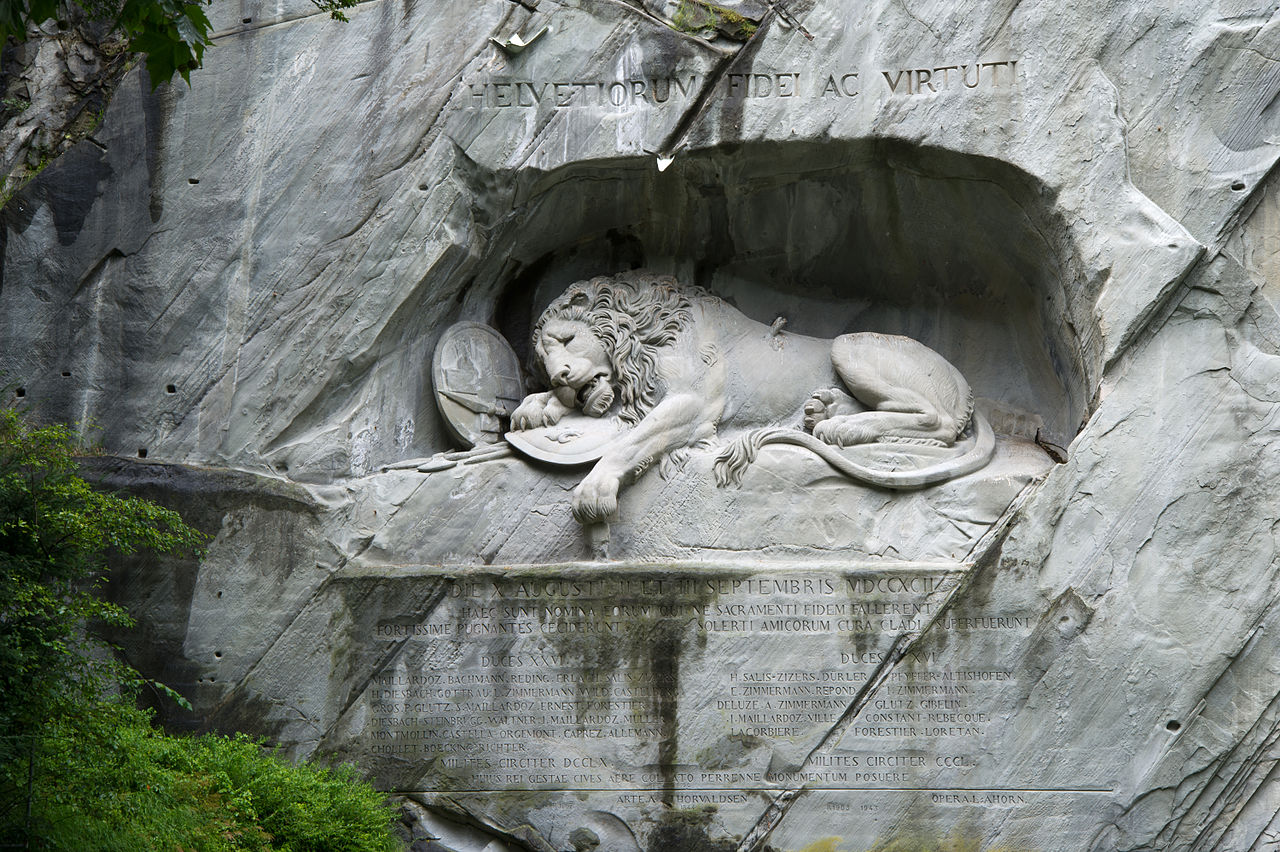
It has also meant moral compromises that older Swiss generations preferred not to examine, and a kind of national identity built on remaining apart while everyone else fought, suffered, and rebuilt. The Lion Monument in Lucerne is the closest the country has to a national war memorial — and it commemorates Swiss mercenaries who died serving a foreign king, not Swiss soldiers defending their own land.
The lesson the Swiss draw from their own history isn't simple. It's more like: peace is possible, but never free, and never innocent.