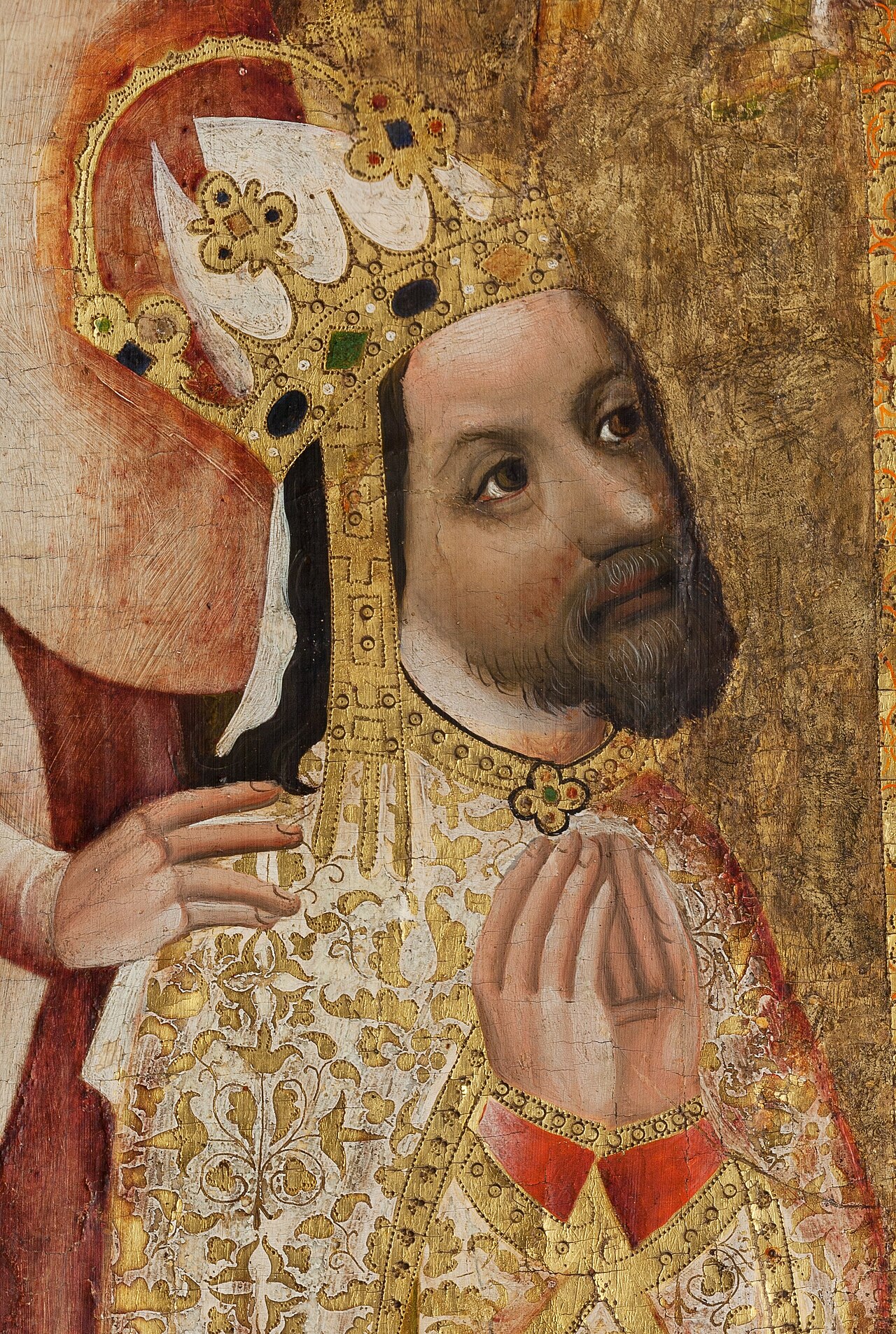
The unlikely emperor
Charles IV was born in Prague in 1316 as Václav (Wenceslas), son of John of Luxembourg (a French-speaking Czech king who barely spoke Czech) and Eliška Přemyslovna (the last princess of the native Czech royal dynasty). He spent his childhood at the French royal court in Paris, where his uncle was Charles IV of France — which is where his Latin name comes from.
He came back to Bohemia at 17 fluent in five languages — Czech, German, French, Italian, Latin — and with one of the best classical educations in medieval Europe. He spent his thirties consolidating power in the Czech lands, then climbed the imperial ladder: King of Bohemia (1346), King of the Romans (1346), Holy Roman Emperor (1355).
What made all this matter for Prague is that, unlike most Holy Roman emperors, Charles made his hometown his capital instead of moving around. The empire effectively governed itself from Prague for thirty years. Money, scholars, artists, and merchants flowed in.
What he built
Walk around Prague today and you are walking through Charles IV's construction project.
New Town (Nové Město), 1348. Prague was already three connected towns — Old Town, Lesser Town, the Castle district. Charles laid out an entirely new fourth one — a planned grid of three vast market squares (today Wenceslas Square, Charles Square, and Senovážné náměstí), wide streets, and city walls. It roughly tripled Prague's footprint overnight. The street grid is still essentially what he drew.
Charles University, 1348. The first university in central Europe. Founded with full papal authorization, with four faculties on the Paris and Bologna model, and explicitly open to all Christian nations. Within decades, students were coming from every corner of the Empire.
Charles Bridge, foundation laid 1357. Replacing an older bridge that had been washed out by a flood. Construction kept going for fifty years. The foundation stone was set at the palindromic moment 1-3-5-7-9-7-5-3-1 (year 1357, ninth day of the seventh month, 5:31 AM) — Charles took his astrologers seriously.
St. Vitus Cathedral. Begun under his father in 1344, with the French master Matthias of Arras directing the design. After Matthias's death, Charles brought in the brilliant young Peter Parler from Schwäbisch Gmünd, whose distinctive Gothic ribbed vaulting and choir gallery still define the cathedral.
Karlštejn Castle, about 30 km outside Prague, was built to house the imperial coronation jewels and the relics Charles collected obsessively — including pieces of the True Cross.
The political theatre
Charles understood that ruling the Holy Roman Empire was as much about pageantry as administration. In 1356, he issued the Golden Bull — a constitutional document spelling out exactly how Holy Roman emperors would be elected from then on (seven electors, named explicitly, with formal procedures). It stabilized imperial succession for the next 400 years.
He was also a relentless collector of saintly relics. Bohemia was a relative latecomer to Christianity, and Charles seems to have decided that if his kingdom couldn't have an ancient ecclesiastical past, it would have the world's most impressive collection of holy bones and splinters. He brought in relics from Aachen, Trier, Rome — body parts of saints from across Christendom, displayed on dedicated reliquary tables.
This was state-building in a medieval idiom: legitimacy through holiness, holiness through accumulation.
What came after
Charles died in 1378 at age 62. His son Wenceslas IV inherited an empire he wasn't suited to run; within a generation the Hussite Wars (1419-1434) had torn Bohemia apart over religion. Prague never quite regained the central position Charles gave it — the Holy Roman emperors after his line preferred Vienna.
But the physical city Charles built has outlasted every regime that came after. Wars, fires, occupations, communism — they all happened around the bones of Charles IV's Prague. When the Velvet Revolution ended communism in 1989, the crowds gathered in Wenceslas Square — a place named for Charles's patron saint, laid out as part of his New Town, surrounded by buildings on land he marked for development 640 years earlier.
What to look for
- The bronze equestrian statue of Charles IV outside the Old Town Bridge Tower, the eastern entrance to Charles Bridge.
- The Karolinum — the historic core of Charles University, near Old Town Square.
- The Saint Wenceslas Chapel inside St. Vitus Cathedral — its walls inset with 1,300 polished semiprecious stones and gold, originally for Charles's coronation regalia.
- Karlštejn Castle — a doable half-day trip from Prague if you want to see his treasure-vault fortress.