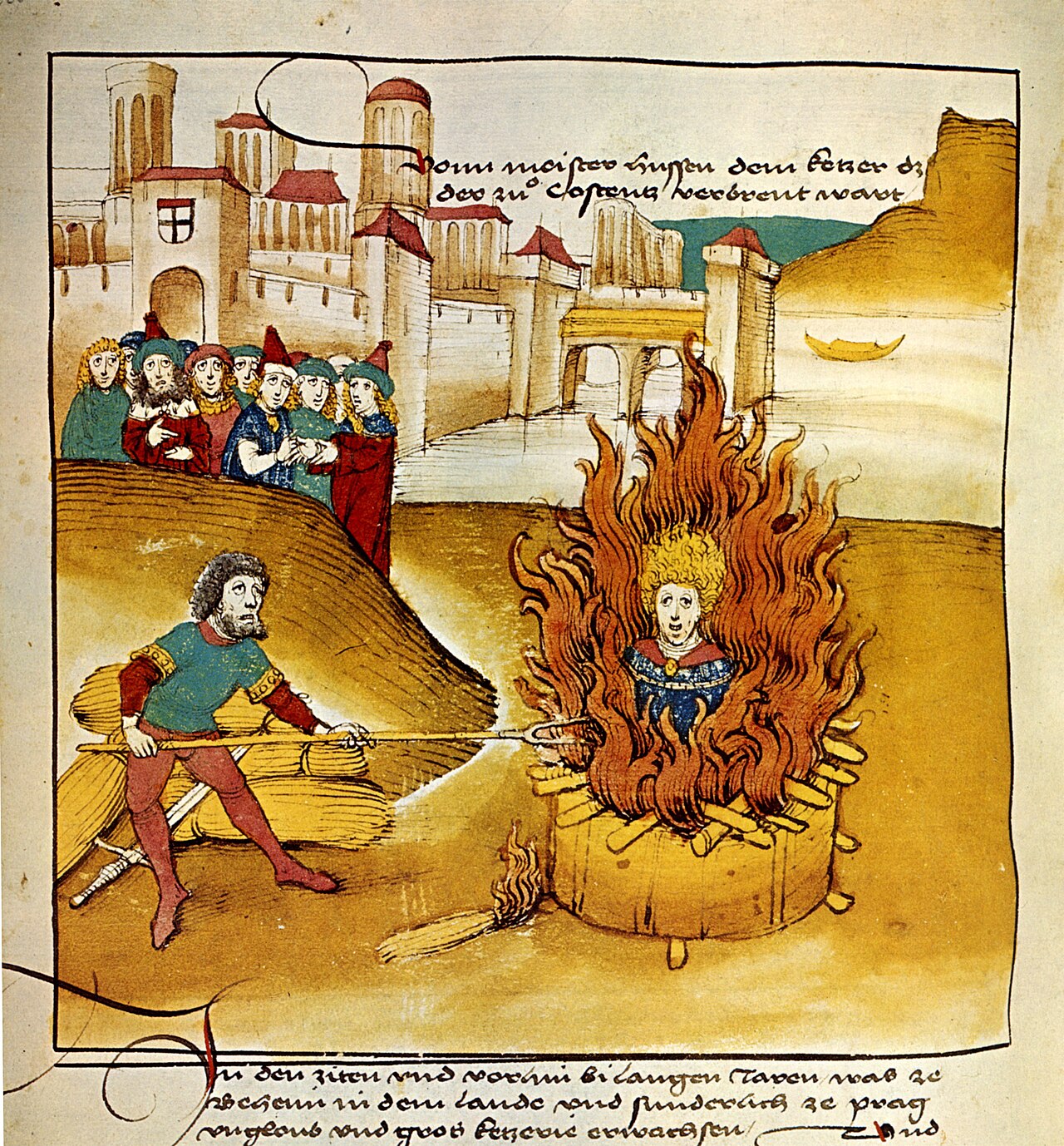
Jan Hus and his idea
In the early 1400s, Jan Hus was the most popular preacher in Prague. He was the rector of Charles University, a Catholic priest who preached in Czech rather than Latin, and the leader of a growing reform movement that wanted four basic things: services in the local language, an end to the sale of indulgences, communion in both bread and wine for laypeople (not just clergy), and a clergy that didn't live like minor nobility.
These ideas weren't unique to him — they overlapped with the English reformer John Wycliffe a generation earlier — but in Prague they caught fire. Sermons at the Bethlehem Chapel drew thousands of people.
The church responded by excommunicating Hus and then summoning him to the Council of Constance in 1414 to defend himself. Promised safe conduct by Emperor Sigismund, Hus travelled to Switzerland in good faith. He was arrested, tried, condemned, and burned at the stake on July 6, 1415. He died praying.
That day became a Czech national holiday. It is still observed.
The Hussite Wars
What might have stayed a theological controversy became a war because of how the Czech response was treated. When five papal armies tried to crush the Hussite movement in successive crusades through the 1420s and 1430s, the Czechs did something nobody expected: they won.
Under the one-eyed general Jan Žižka, an outnumbered force of Czech peasants and minor nobility invented new tactics — armoured war wagons mounted with the first effective field cannon, used to break up cavalry charges. Žižka never lost a battle. After his death, the Hussites kept winning until the movement split internally; the moderate wing finally negotiated a settlement with the Catholic Church in 1436.
The settlement let Bohemia keep its distinctive reformed practices (especially the famous chalice symbol — communion in both kinds for the laity). The Catholic Church effectively recognized a Protestant region 100 years before Martin Luther.
White Mountain — the disaster
The truce held, more or less, for nearly two centuries. Bohemia stayed Protestant-leaning under Habsburg rulers who were Catholic but mostly didn't push. By the early 1600s, the religious balance in the Holy Roman Empire was tense everywhere. Bohemia's Protestant nobility, fearing a Habsburg crackdown, defenestrated two imperial officials from a Prague Castle window in May 1618 (they survived — perhaps the famous dung-heap) and elected their own Protestant king, Frederick V of the Palatinate.
This started the Thirty Years' War — the most destructive European war before the 20th century.
For the Czech lands, the war ended almost before it began. On November 8, 1620, at the Battle of White Mountain outside Prague, the Habsburg Catholic army crushed the Bohemian Protestants in a couple of hours. The consequences for Bohemia were catastrophic:
- 27 Protestant leaders publicly executed in Old Town Square in 1621 (the 27 crosses in the cobblestones in front of the Old Town Hall mark the spot).
- Protestantism made illegal.
- About 150,000 Czech Protestants forced into exile, including the educator Jan Amos Komenský (Comenius).
- The Czech language driven out of public life, replaced by German for the next 200 years.
For Europe as a whole, the Thirty Years' War continued until 1648, killing an estimated 4-8 million people across central Europe and devastating much of what is now Germany.
The long shadow
The defeat at White Mountain marked the end of Czech political and religious independence for the next three centuries. Bohemia stayed Habsburg until 1918. The Czech Catholic church that re-emerged in the 17th century was imposed from outside; many Czechs never fully accepted it.
When the modern Czech national revival picked up in the 19th century, it reached back past Catholicism — past the whole Habsburg period — to Hus and the Hussites as the foundational Czech identity. The Czechoslovak state founded in 1918 took Hus as a national hero, not a Catholic saint. Under communism, of course, religion was repressed entirely.
The result is that Czechia is today the most non-religious country in Europe by most measures — around 70% of Czechs claim no religion. The Catholic Church is associated, in folk memory, with foreign rule and forced re-conversion. Five centuries after Hus was burned for trying to reform Catholicism, his country mostly walked away from the whole conversation.
Where to see it
- The Bethlehem Chapel in Prague — reconstructed in the 1950s on the site where Hus preached.
- The Hus Monument in Old Town Square — unveiled on July 6, 1915, the 500th anniversary of his execution.
- The 27 white crosses on the cobblestones outside the Old Town Hall — marking the 1621 executions.
- The St. Wenceslas Chapel inside St. Vitus Cathedral — where the surviving Bohemian crown jewels are kept under seven locks (seven different officials hold the keys; opened only on rare occasions).