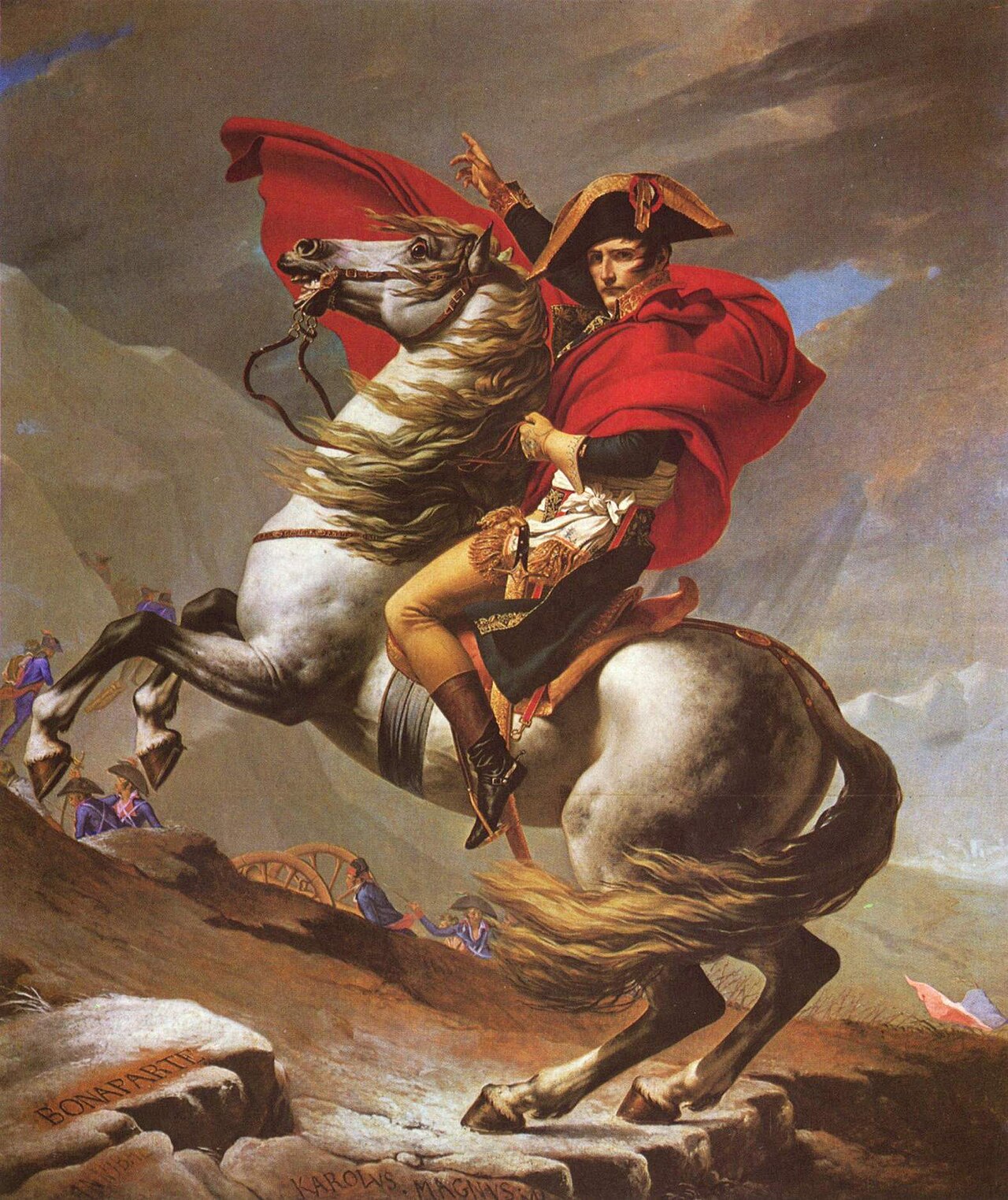
The Corsican
Napoleon Bonaparte was born in 1769 in Ajaccio, Corsica — an island that had been French for exactly one year. He grew up speaking Corsican Italian, learned French at military school in mainland France, and was teased for his accent. He'd later end up with absolute power over the country whose language he'd mangled as a boy.
He became an artillery officer in the Royal Army, then survived the Revolution by being useful to whoever was in charge that month. In 1793, at the siege of Toulon, he showed a flair for putting cannons in the right place; by 1796, at 26, he was commanding the French army in Italy and winning battles he had no business winning.
Coup, consul, emperor
By 1799 the French Revolution had collapsed into the corrupt and exhausted Directory. Napoleon — newly back from a military adventure in Egypt — staged a coup with allies on 18 Brumaire (November 9, 1799). He installed himself as First Consul, then in 1804 had himself crowned Emperor of the French.
Famously, at the coronation in Notre-Dame, he took the crown from the Pope's hands and placed it on his own head. The Pope had travelled from Rome for the ceremony.
The conquest of Europe
For roughly a decade, Napoleon's Grande Armée did the impossible at a steady pace:
- Austerlitz (1805) — destroyed the combined Austrian and Russian armies in a single afternoon. Considered his masterpiece.
- Jena-Auerstedt (1806) — annihilated Prussia in a day. Berlin fell two weeks later.
- Wagram (1809) — broke Austria a second time.
At his peak in 1812, Napoleon's empire and its satellite kingdoms stretched from Spain to the Russian border. He had installed his brothers and brothers-in-law as kings of Holland, Spain, Naples, and Westphalia. He'd married into the Habsburg dynasty (Marie Louise of Austria — niece of the Marie Antoinette he had not, personally, executed).
He kept losing armies and raising new ones because the new model of citizen-soldier warfare he'd inherited from the Revolution meant France could put more men in uniform than any rival.
The fall
Napoleon's downfall began with two strategic mistakes.
- The invasion of Russia, 1812. He marched in with ~600,000 troops; he came out with around 100,000. The Russians refused to give him a decisive battle, burned everything as they retreated, and let the Russian winter do the rest.
- The Spanish ulcer. His attempt to put his brother on the Spanish throne triggered a vicious guerrilla war that bled French manpower for years.
A coalition of every other major European power (Britain, Russia, Prussia, Austria) finally cornered him. He abdicated in 1814 and was exiled to the Mediterranean island of Elba. Less than a year later he escaped, raised an army by marching toward Paris while everyone he met joined him, and ruled France again for a hundred days before being defeated at Waterloo in June 1815 by the British and Prussians.
This time the British were taking no chances. He was shipped to St. Helena, a remote island in the South Atlantic, and died there in 1821 — possibly of stomach cancer, possibly of arsenic poisoning from the wallpaper, depending which historian you trust.
What he left
For all the wars, Napoleon's longest legacy is administrative.
- The Napoleonic Code (1804) — a single, rationalized civil law replacing the patchwork of feudal customs France had inherited. Equality before the law, secular marriage and divorce, property rights, no nobility privileges. Versions of it are still in force in much of continental Europe, Louisiana, Quebec, parts of the Middle East, Japan, and Latin America. Roughly a third of humanity lives under a legal system descended from the Code.
- Modern bureaucracy — prefectures, lycées, the Légion d'Honneur, the metric system (which the Revolution invented but Napoleon enforced), and a school system designed to produce technocrats.
- The map of Europe — by knocking down the Holy Roman Empire and consolidating dozens of tiny German states, he accidentally cleared the ground for the eventual unification of Germany under Prussia.
His tomb is in Les Invalides in Paris — a colossal red porphyry sarcophagus on six nested coffins (he insisted on six because he didn't want anyone digging him up again).