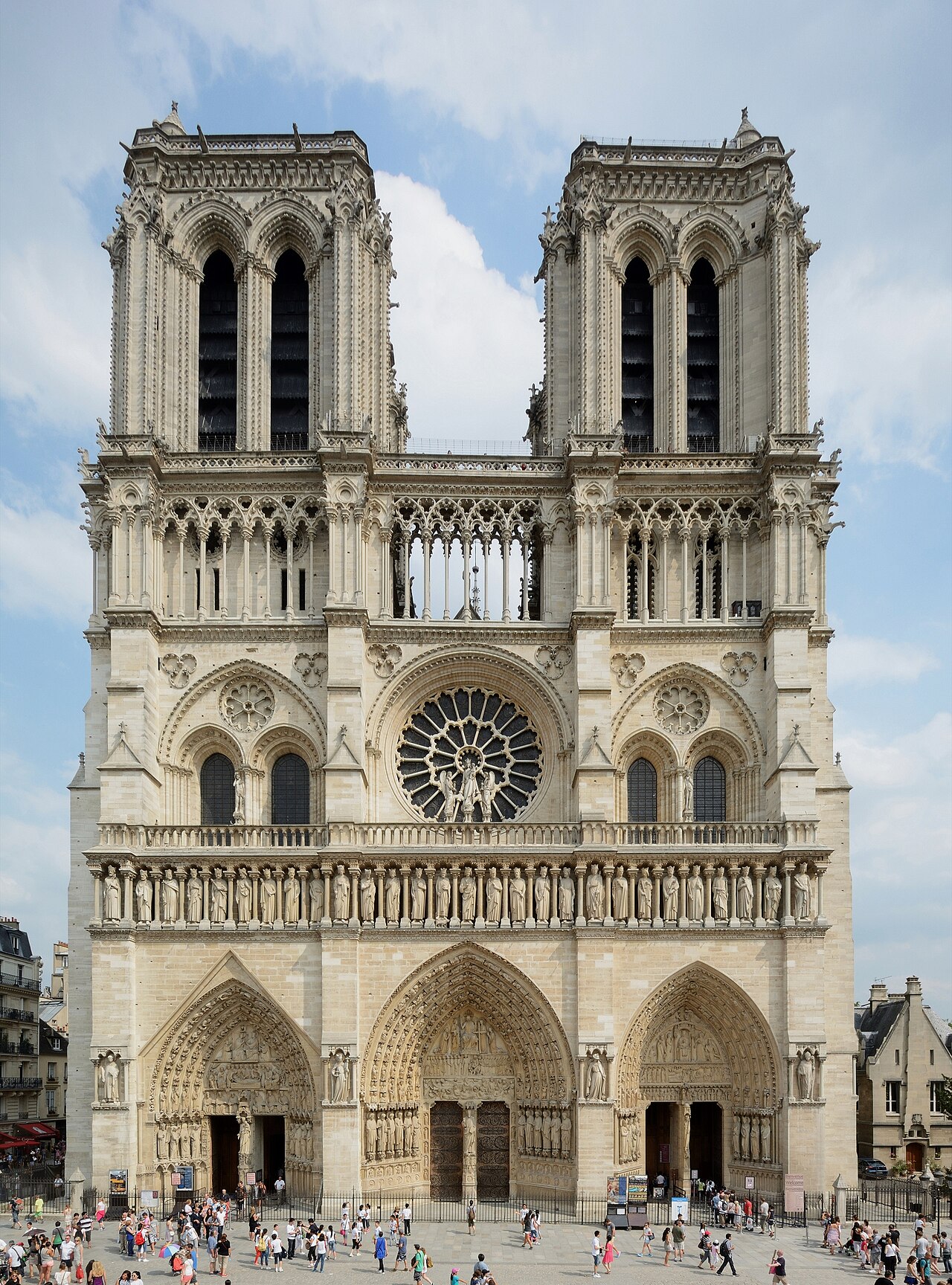
Built across centuries
Construction of Notre-Dame began in 1163 under Bishop Maurice de Sully and took about two centuries to finish. That alone tells you something about the medieval relationship to time: every person who laid the first stones was already dead long before anyone saw the towers rise.
The cathedral represents an early flowering of Gothic architecture — the new style of ribbed vaults, flying buttresses, and enormous stained-glass windows that French masons were inventing in the 12th and 13th centuries. The choir was finished by 1182, the western façade with its two towers by about 1245, the spire (the flèche) by the 13th century. Each generation added.
Revolution and ruin
During the French Revolution, Notre-Dame had a bad decade. Revolutionaries decapitated the statues of biblical kings on the façade — mistaking them for kings of France. The cathedral was rededicated as a Temple of Reason in 1793. The bells were melted down for cannon. The treasury was looted. The building was used at one point as a wine warehouse.
By the early 19th century, Notre-Dame was structurally sound but visibly battered, with leaking roofs and gaps where statues used to be. It was nearly demolished.
What saved it was a novel.
How a novel rebuilt a cathedral
In 1831, Victor Hugo published Notre-Dame de Paris (titled The Hunchback of Notre-Dame in English). Hugo wrote the book partly as protest — he was furious at the neglect of medieval architecture in Paris — and made the cathedral itself a character. The book was an instant sensation.
Public opinion shifted. A massive restoration was commissioned in 1844 under Eugène Viollet-le-Duc, the architect who effectively reinvented French Gothic restoration as a discipline. He rebuilt the spire (slimmer and taller than the original), added the famous chimera grotesques along the gallery (yes, the gargoyles are 19th-century), and re-carved the lost statues. Much of what tourists now see is Viollet-le-Duc's loving reconstruction more than it is medieval.
The 20th century
Notre-Dame held Napoleon's coronation in 1804. It hosted the funeral of every French president of the 19th and 20th centuries. It survived two world wars, including a 1944 service marking the liberation of Paris where a sniper fired into the cathedral during the Magnificat.
By the 2010s, the cathedral was again in trouble. Pollution had eaten the limestone. Stones were falling from the spire. A major fundraising restoration was finally under way when, on the evening of April 15, 2019, a fire broke out in the wooden roof during construction work.
The fire and what came back
The world watched the spire collapse on live television. For a few hours that night it was unclear whether the cathedral itself would survive — fire crews fought to keep the flames out of the two stone bell towers, which would have spread the heat to the wooden bell-frames inside.
What survived:
- The stone vaulted ceiling held, doing exactly what Gothic engineering was designed to do — contain a roof fire from collapsing the building below.
- The three medieval rose windows survived almost intact.
- The Crown of Thorns, the high altar, the great organ — all saved by firefighters and clergy who ran into the burning building.
What was lost:
- The 19th-century spire and the lead roof above the vaults.
- The 13th-century wooden roof structure — known as la forêt (the forest) — built from over a thousand oak trees.
The restoration took five years. President Macron promised "more beautiful than before" within five years, and almost incredibly, it was. France found roughly 1,000 oak trees of the right age and size from forests across the country. Master carpenters cut and joined them using medieval techniques. The cathedral reopened to worship on December 7, 2024.
What to look for when you visit
- The three rose windows — north, south, west. Look up.
- The Galerie des Chimères — those famous chimera grotesques. 19th century, not medieval. Still extraordinary.
- The archaeological crypt below the forecourt — Roman walls of the original Lutetia, the village that became Paris.
- The point zéro marker in the square in front — a bronze star marking the official centre of France for road distances.