What this page is for
This is a short, accurate summary of one of the worst things that has ever happened in human history, set in the part of Poland we're visiting. It is appropriate for adults and older teenagers. It is not graphic but it is direct, because the topic doesn't survive softening. If anyone in the family wants to go visit, this is also useful background.
Why Poland
Before World War II, Poland was home to the largest Jewish community in Europe — about 3.3 million people, roughly 10% of the country. Polish Jewish culture was old (going back roughly 800 years), distinctive (Yiddish literature, theatre, music, an enormous religious-scholarship tradition), and concentrated in cities like Warsaw, Łódź, Lublin, and Kraków. The Kazimierz district of Kraków had been Jewish for nearly 500 years.
When Nazi Germany and the Soviet Union jointly invaded Poland in September 1939, German-occupied Poland came under direct Nazi administration. The Nazis chose to carry out the mass murder of Europe's Jews here — not because Poland was particularly antisemitic by European standards of the time, but because most of Europe's Jewish population was already in Poland. The Nazis brought the rest from across occupied Europe by rail.
The camps
The Nazis built several different kinds of camps in occupied Poland, often using the same names imprecisely:
- Concentration camps like Auschwitz I or Dachau (which was in Germany) were forced-labour and political-prisoner camps. People were worked, starved, and beaten; many died, but the camps' purpose was control, not extermination.
- Death camps (sometimes called extermination camps) were something new — industrial facilities built solely to kill people on arrival. There were six of them, all in occupied Poland: Chełmno, Bełżec, Sobibór, Treblinka, Majdanek, and Auschwitz-Birkenau.
Auschwitz is the one most people have heard of because it was the largest, and because — uniquely — it functioned as both a concentration camp and a death camp.
Auschwitz
The complex was built outside the Polish town of Oświęcim (the German rendering was Auschwitz), about 70 km west of Kraków. It had three main parts:
- Auschwitz I, a former Polish army barracks the Nazis converted in 1940 — initially for Polish political prisoners, later expanded.
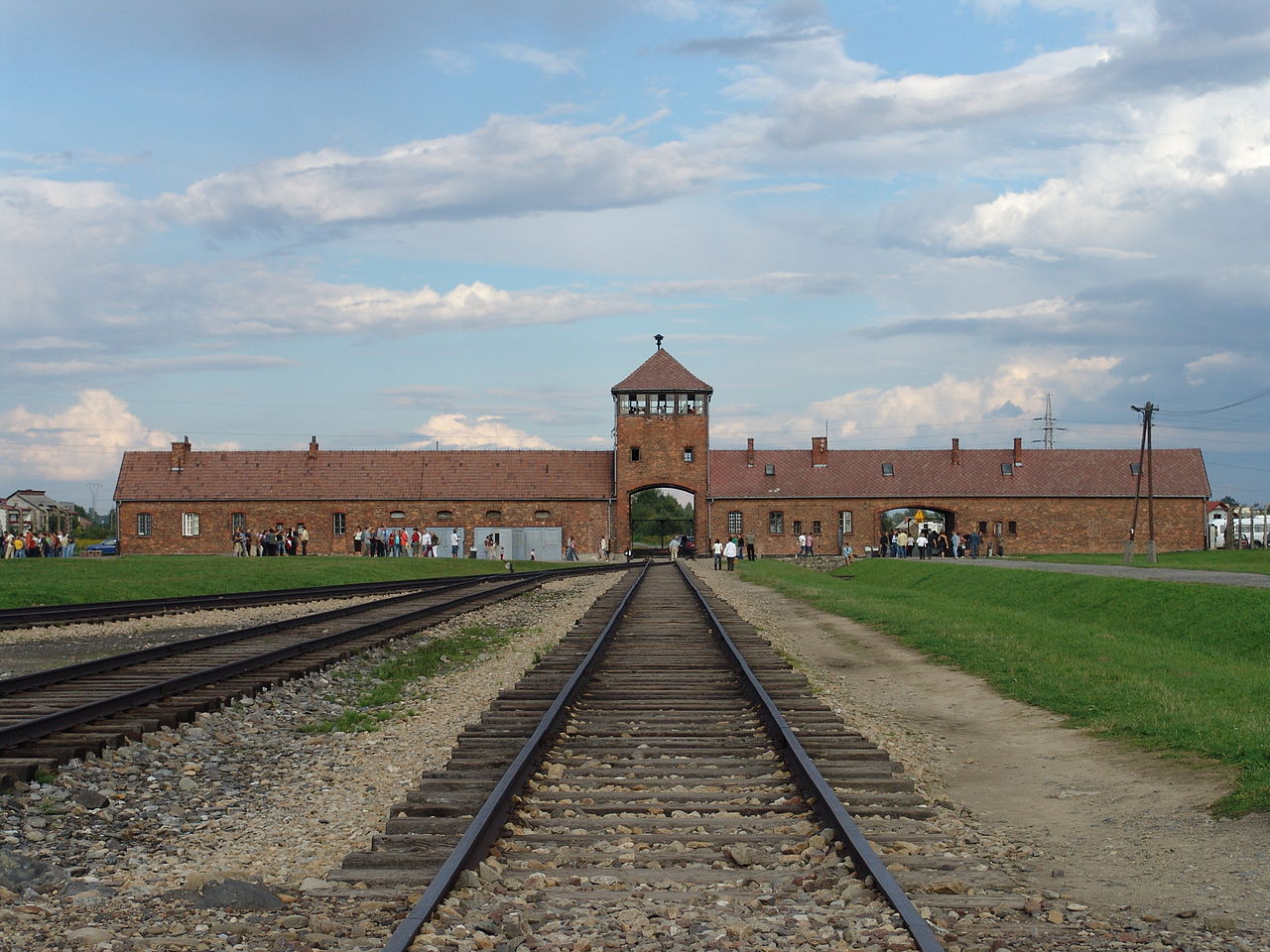
- Auschwitz II (Birkenau), two kilometres away, built in 1941 — much larger, with the four large purpose-built gas chambers and crematoria, the unloading ramp where new arrivals were "selected" for immediate murder or for temporary forced labour.
- Auschwitz III (Monowitz), a satellite labour camp attached to an IG Farben synthetic-rubber factory.
About 1.1 million people were murdered at Auschwitz between 1940 and 1945:
- Around 1 million Jews from across Europe — Polish, Hungarian, French, Dutch, Greek, Italian, German, and dozens of other communities.
- Approximately 70,000 Poles — Catholic political prisoners, intellectuals, resistance members.
- About 21,000 Roma (Sinti and Roma).
- About 15,000 Soviet prisoners of war.
The killings were industrial. New arrivals — many having travelled in sealed cattle cars for days without food or water — were sorted on the railway ramp by an SS doctor. Roughly three-quarters were sent directly to gas chambers within hours. The rest were tattooed with prisoner numbers and worked, in conditions designed to kill, until they couldn't work anymore — then they too were gassed.
The whole system was operated by a relatively small SS staff and a much larger group of imprisoned Sonderkommando — Jewish prisoners forced under threat of death to clean out the chambers and feed the bodies into crematoria. They were themselves killed every few months and replaced. A few left buried journals that survived the war.
Kraków during the occupation
In Kraków itself, the Germans made the city the capital of the Generalgouvernement — the central administrative zone of occupied Poland. Hans Frank, the Nazi governor, ran the territory from Wawel Castle.
About 60,000 Jews lived in Kraków in 1939. In March 1941, the Germans forced the remaining Jewish population into a sealed ghetto in the Podgórze district (south of Kazimierz, across the river). Conditions there were intentionally lethal: starvation rations, overcrowding, no medicine.
Over 1942-1943 the ghetto was emptied in stages. The first deportations sent most of the inhabitants to Bełżec — a pure death camp where they were killed within hours of arrival. The final liquidation, in March 1943, deported the remainder to the Płaszów labour camp on the southeast edge of Kraków (the camp later commanded by the brutal Amon Göth) or directly to Auschwitz.
A few — about 1,200 — were saved by Oskar Schindler, who initially used them as cheap factory labour and over time risked his life to keep them alive. His enamel factory at ul. Lipowa 4 is now a museum.
What you'll see if you go
Auschwitz-Birkenau is a State Museum and Memorial. It is free to visit; in high season you must reserve a timed entry. The site has been preserved mostly as it was found on liberation day, January 27, 1945:
- The original gate at Auschwitz I, with its bitter inscription Arbeit Macht Frei — "work sets you free."
- Block 11 — where the first gas-chamber tests were conducted on Soviet POWs.
- The crematorium ruins at Birkenau — blown up by the SS in 1944-1945 to try to hide evidence. The pieces are still there.
- The selection ramp — where families were separated and most people sent directly to the gas chambers.
- Mountains of personal possessions — suitcases, eyeglasses, shoes, children's toys, women's hair — taken from the murdered and preserved as evidence.
The Polish and Israeli school groups walk through silently. Visitors are asked not to take selfies, not to walk on the railroad tracks at the selection ramp, and not to smoke.
What it asks of us
The Holocaust killed approximately 6 million Jews across Europe — about two-thirds of Europe's prewar Jewish population. It also killed millions of Roma, Soviet citizens, Poles, disabled people, and others the Nazi state classified as undesirable.
The lesson historians have drawn from Auschwitz is not just "that one regime did a bad thing." It is that mass murder at this scale required hundreds of thousands of ordinary functionaries — train conductors, factory managers, accountants, soldiers — who chose to participate in or look away from a system that any one of them could see was monstrous. The question that haunts the literature is what made so many of them say yes.
Visiting Auschwitz is not pleasant, and not really meant to be. It is an obligation that the post-war world set itself: to make sure the killing was recorded and remembered in such a specific, irrefutable way that no future regime could claim "this didn't happen" and be believed.
January 27 — the date the Red Army reached the gates of Auschwitz in 1945 — is now International Holocaust Remembrance Day.
Where to see it in Kraków
- Schindler's Factory at ul. Lipowa 4 — the museum is more about Kraków under occupation than about Schindler himself.
- The Eagle Pharmacy on Plac Bohaterów Getta — the only non-Jewish business inside the ghetto wall, whose Polish pharmacist Tadeusz Pankiewicz documented and helped countless ghetto residents. Now a small museum.
- Galicia Jewish Museum in Kazimierz — photographs documenting Jewish life in Galicia before, during, and after the Holocaust.
- The old synagogues of Kazimierz — most have reopened as cultural sites since the 1990s.
- Auschwitz-Birkenau itself — bookable as a day trip from Kraków through any travel agent or directly with the museum.