The Commonwealth that couldn't decide anything
To understand how Poland disappeared, it helps to know what it was first.
By the 17th century, the Polish-Lithuanian Commonwealth was one of the largest states in Europe — stretching from the Baltic Sea to the edge of the Black Sea, covering modern Poland, Lithuania, Belarus, most of Ukraine, and parts of Latvia, Russia, and Slovakia. It had elected its kings since 1573 (most European monarchies were strictly hereditary), guaranteed religious tolerance well before any of its neighbours, and hosted one of Europe's largest Jewish communities.
It also had a fatal political flaw: the liberum veto. Any single member of the Polish parliament (Sejm) could veto any law — and not just block it, but break up the entire parliamentary session, voiding every other decision it had made. The principle was that unanimous consent of the nobility was sacred. The practical effect was that bribing one minor nobleman was enough to paralyse the Polish state.
By the mid-1700s, almost every Sejm was breaking up without passing anything. The army was tiny. The treasury was empty. Foreign ambassadors openly bought votes. Poland's three more autocratic neighbours — Russia, Prussia, Austria — could not believe their luck.
Three partitions in twenty-three years
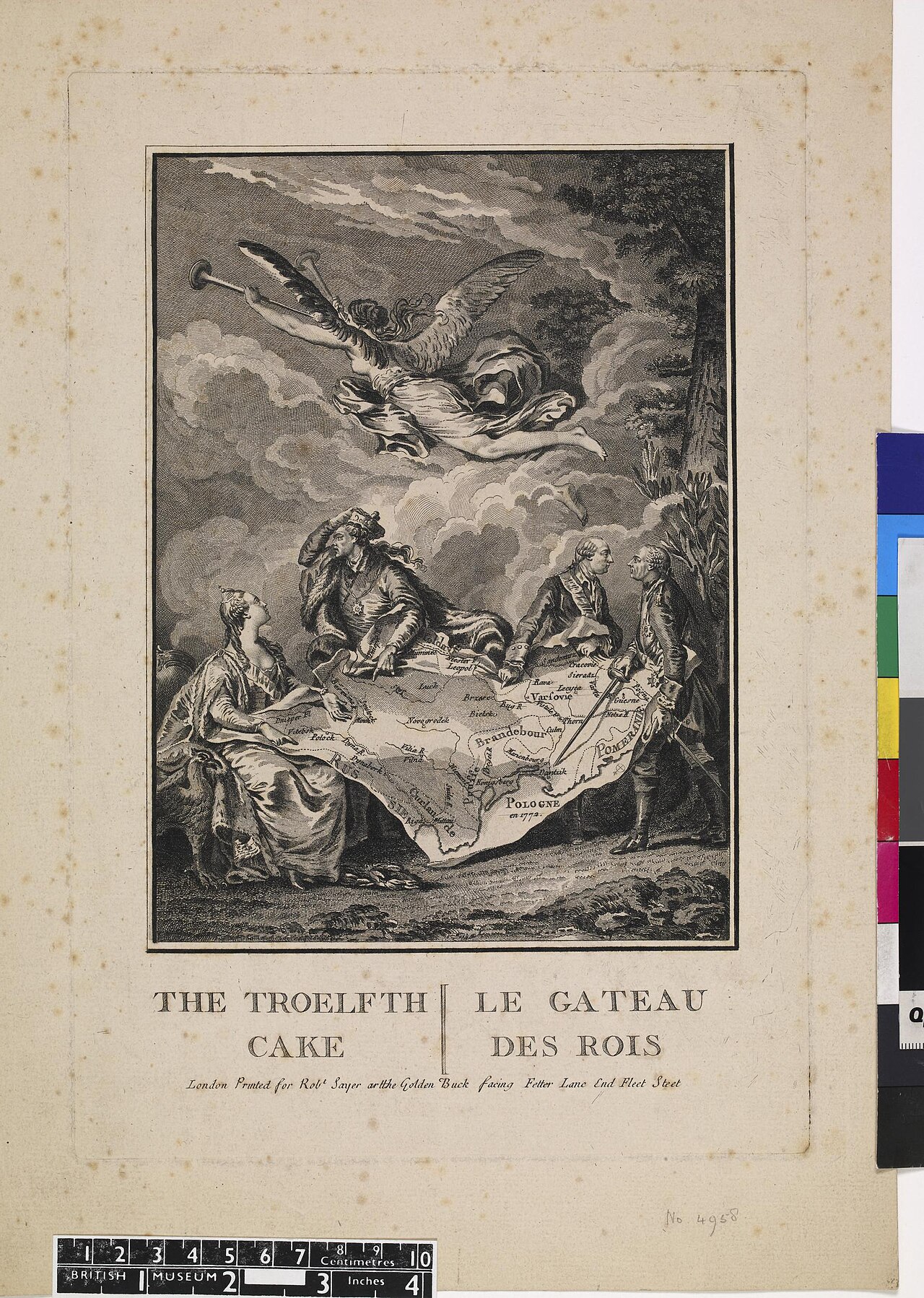
The First Partition (1772). Russia, Prussia, and Austria carved off about a third of the Commonwealth's territory between them, with a polite legal fiction that they were "rationalizing borders." Poland's powerless king was forced to ratify it.
The shock prompted a wave of belated reform. Polish patriots wrote the Constitution of May 3, 1791 — the second written national constitution in the world after the United States'. It abolished the liberum veto, made the monarchy hereditary, and modernized the state.
Russia and Prussia, alarmed at Poland actually fixing itself, invaded.
The Second Partition (1793). Another third of what was left, taken by Russia and Prussia.
A national uprising under Tadeusz Kościuszko in 1794 (the same Kościuszko who had earlier helped George Washington in the American Revolution) tried to save what remained. The uprising was crushed.
The Third Partition (1795). The last fragment, divided. Poland ceased to exist as a state. The maps of Europe printed after 1795 showed three different colours where there had been one country.
123 years of resistance
Between 1795 and 1918, Poland was not a country. Polish speakers became subjects of three different empires: the Russian zone (the biggest, including Warsaw), the Prussian zone (Poznań and the Baltic coast), and the Austrian zone called Galicia (including Kraków, which is why much of what's most iconically Polish — Wawel Castle, the salt mines, Jagiellonian University — sits in the formerly Austrian portion).
What kept Polish identity alive through five generations of foreign rule:
- The Catholic Church. Polish Catholicism became inseparable from Polish nationhood. Russian Orthodox and Prussian Protestant rulers treated this as a problem to be solved; it didn't solve.
- The language. Polish was taught in private homes, in clandestine "Flying Universities," sometimes literally underground. Marie Curie's family was part of this resistance education in Russian Warsaw.
- The literature. Poets like Adam Mickiewicz, writing from exile in Paris, kept producing Polish-language masterworks that everyone could read. Pan Tadeusz — Mickiewicz's 1834 verse epic — is still memorized by Polish schoolchildren.
- Uprisings. The November Uprising of 1830-31 and the January Uprising of 1863-64 both failed and led to brutal Russian reprisals. They mattered anyway. Each generation had to know it could fight.
- Music. Chopin wrote almost his entire output in exile in Paris after fleeing the November Uprising. His music was understood — by Poles and by Europeans generally — as Poland refusing to be erased.
A nation can survive without a state, but only for a generation or two — unless the cultural infrastructure is deep enough. Poland's was.
The return
The collapse of Russia, Germany, and Austria-Hungary in World War I finally cleared the way. On November 11, 1918, the day the Western Front ended, Poland declared independence under Józef Piłsudski.
The new Poland had to fight Soviet Russia immediately (winning the Battle of Warsaw in 1920, a victory remembered as the "Miracle on the Vistula"), then build a state from three different legal systems, three different rail gauges, and three different generations of foreign rule.
That Poland lasted twenty years before being partitioned again — in September 1939, by Nazi Germany and the Soviet Union under the Molotov-Ribbentrop Pact. World War II killed about 6 million Polish citizens, half of them Polish Jews.
Poland re-emerged after 1945 as a Soviet satellite state, not fully sovereign again until 1989.
What the partitions left
Poles still feel the partitions in concrete ways:
- Different regional cultures. Kraków (formerly Austrian) and Warsaw (formerly Russian) and Poznań (formerly Prussian) have noticeably different architecture, food, and even attitudes toward bureaucracy.
- A pattern of viewing the state with suspicion. When your government for five generations was a foreign occupier, you learn to organize without it. Polish civil society — neighbourhood mutual-aid networks, Catholic parishes, scout troops — has remained unusually strong.
- A determination that disappearance can happen again. Modern Polish foreign policy makes more sense if you remember that Poland's neighbours have erased it from the map within living memory of people still alive.
Where to see it
- Wawel Castle and Cathedral in Kraków — the royal seat of the old Commonwealth, kept symbolically Polish through the Austrian partition.
- Kazimierz — Kraków's Jewish quarter, central to the old Commonwealth's religious tolerance and to the tragedy of the 1940s.
- The Cloth Hall — the Renaissance heart of Kraków's market square, surrounded by buildings that survived empires.