A Polish pope
On October 16, 1978, white smoke rose over the Sistine Chapel and the world learned that the new pope was a Polish cardinal: Karol Wojtyła, Archbishop of Kraków. He took the name John Paul II.
It is hard to overstate how unsettling this was for the Polish communist government. Poland was a Soviet satellite. Religion was officially atheist Marxism. And now the head of the most powerful pre-modern institution still operating in Poland — the Catholic Church — was a Polish bishop most Poles already knew, with a direct line to roughly 90% of the country's population.
In June 1979 John Paul II made his first papal pilgrimage to Poland. The government tried to play it down: state TV refused to broadcast the open-air masses. It didn't matter. Across nine days, an estimated 11 million Poles — about a third of the country — came out to see him in person. He didn't preach revolution. He didn't have to. He simply repeated, in person, in Polish, that Poles were not alone, that their identity was not what the state said it was, that "be not afraid" was the message of the gospel.
People came home from those masses and started organizing.
The August strikes
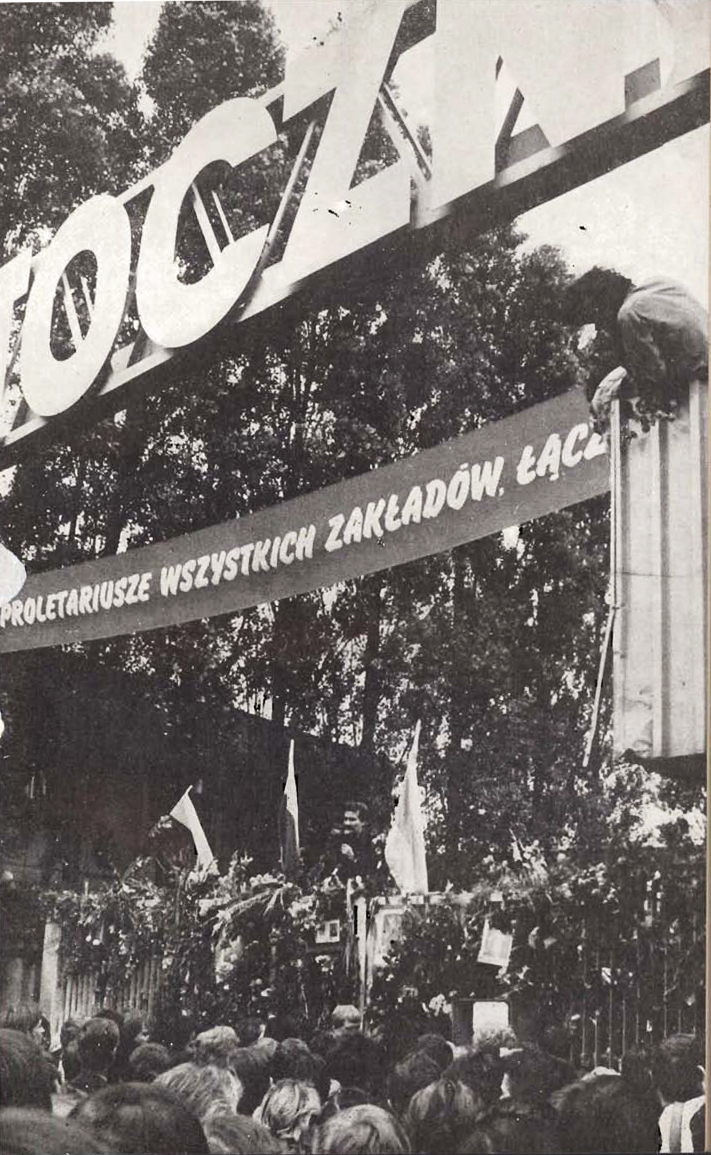
In August 1980, workers at the Lenin Shipyard in Gdańsk went on strike — initially over the firing of a popular crane operator named Anna Walentynowicz. The strike spread along the Baltic coast within days. An electrician named Lech Wałęsa, who had been fired from the shipyard years earlier for political activism, climbed over the fence to join.
The strikers' demands escalated from wages to politics: the right to form an independent trade union, the right to strike, freedom of expression, the release of political prisoners, an end to censorship.
Astonishingly, on August 31, 1980, the communist government signed an agreement granting most of these demands. The new union — Solidarność (Solidarity) — was the first independent trade union in any country of the Eastern Bloc.
By the next year, Solidarity had 10 million members — roughly a quarter of the entire population of Poland. It was less a labour union than a national movement that happened to have the legal form of one.
Martial law
The Soviet Union was not going to let this stand without a fight. In December 1981, Polish General Wojciech Jaruzelski declared martial law. Tanks took to the streets. Thousands of Solidarity activists were interned without trial. Wałęsa was arrested. The union was driven underground.
What happened next is the part that's harder to explain than the famous moments. For the next seven years, Solidarity continued to exist as a vast clandestine network — running illegal printing presses, smuggling books across the Baltic, organizing strikes and slow-downs, broadcasting illegal radio. The communist government couldn't kill it without becoming so visibly tyrannical that even its own apparatus would crack. It also couldn't co-opt it.
In 1983, Wałęsa won the Nobel Peace Prize while officially being an unemployed electrician under government surveillance.
In 1984, Father Jerzy Popiełuszko — a young priest associated with Solidarity — was kidnapped and murdered by the Polish secret police. His funeral, attended by 250,000 people, made the international news. The government had to put the murderers on trial. The trial backfired: the testimony made the secret police's methods part of the public record.
The round table
By 1988 the Polish economy was in free fall. A wave of strikes broke out that the government couldn't suppress. The government did what the Soviet Union and its own party were unwilling but unable to forbid: it sat down at a round table with Solidarity in February 1989 and negotiated.
The agreement that came out of those talks legalized Solidarity again, scheduled partly-free elections in June 1989, and recognized the union's right to organize politically.
What happened next surprised everyone. In the June 1989 elections — which the communists had designed to limit Solidarity to 35% of the lower house — Solidarity won every single seat it was allowed to contest, plus 99 out of 100 in the Senate. The communist party's own candidates, running uncontested in safe seats, failed to get the required 50% of votes in many cases.
The communist government collapsed by August. Tadeusz Mazowiecki, a Solidarity advisor, became the first non-communist prime minister in the Eastern Bloc since the 1940s.
Why it mattered for everyone else
The Polish breakthrough in summer 1989 was the first crack in the Eastern Bloc. Within months:
- Hungary opened its border with Austria, letting East Germans flee west.
- The Berlin Wall fell (November 1989).
- The Velvet Revolution overthrew communism in Czechoslovakia (November-December 1989).
- Romania's Ceaușescu was executed by his own people (December 1989).
- By 1991, the Soviet Union itself was gone.
The whole cascade ran on a logic Solidarity had established: a communist state could not maintain its claim to legitimacy if it had to negotiate with an opposition that represented an entire society. Once Poland proved that, the rest of the dominoes were in motion.
In December 1989, Wałęsa addressed the U.S. Congress as the leader of a free Polish nation. In 1990 he was elected president of Poland. Mazowiecki and Wałęsa eventually fell out — the new Poland had its share of political feuds — but the country they had helped midwife was real.
Where to see it (or feel it)
- In Kraków, Wawel Cathedral — where John Paul II said his first mass as a young priest, and where his memorial bell, Sigismund, was rung for his funeral.
- In Kraków, the Pope John Paul II Family Home Museum in Wadowice (50 km from Kraków, doable as a half-day trip) — his actual childhood apartment.
- Across Poland, memorials to murdered priests and Solidarity activists are everywhere, often in cathedral side-chapels. They tend to be quiet.
- The shipyard gates in Gdańsk, where the August 1980 agreement was signed, are now a museum — too far from this trip's route, but worth knowing about.